
18% vs. 13% Returns: Which Real Estate Investment Would You Choose?
18% vs. 13% Returns: Which Real Estate Investment Would You Choose?
The difference between chasing returns and building wealth often comes down to what investors overlook.
Two multifamily investment opportunities land on your desk.
One projects an 18% annualized return. The other projects 13%.
Which would you choose?
Most investors would instinctively gravitate toward the 18% opportunity. After all, who wouldn't want a higher return?
But experienced investors understand something important:
The better question isn't how much an investment could earn. It's what has to go right to achieve that return.
And that's where the real evaluation begins.
1. The Numbers Behind the Numbers
Consider two hypothetical $30 million multifamily acquisitions.
Investment assumptions | Property A | Property B |
|---|---|---|
Projected annualized IRR | 18% | 13% |
Annual rent growth | 5% | 2% |
Financing | Floating rate | Fixed rate |
Exit assumptions | Optimistic | Conservative |
Interest rate exposure | Higher | Lower |
Illustrative assumptions only. Neither return is guaranteed.
Property A looks more profitable on paper. But its success depends on aggressive rent growth, favorable financing conditions, and a strong exit valuation.
Property B projects a lower return but relies on more conservative assumptions.
The lesson? A higher projected return doesn't necessarily mean a better risk-adjusted investment.
2. How a $100,000 Miss Can Cost Investors $2 Million
Here's where underwriting becomes particularly important.
Imagine a 200-unit apartment community where operating income falls $100,000 below projections.
Perhaps occupancy declines. Insurance premiums increase. Or rental growth doesn't materialize as expected.
At a 5% capitalization rate, that $100,000 reduction in annual net operating income translates into approximately $2 million in lost property value.
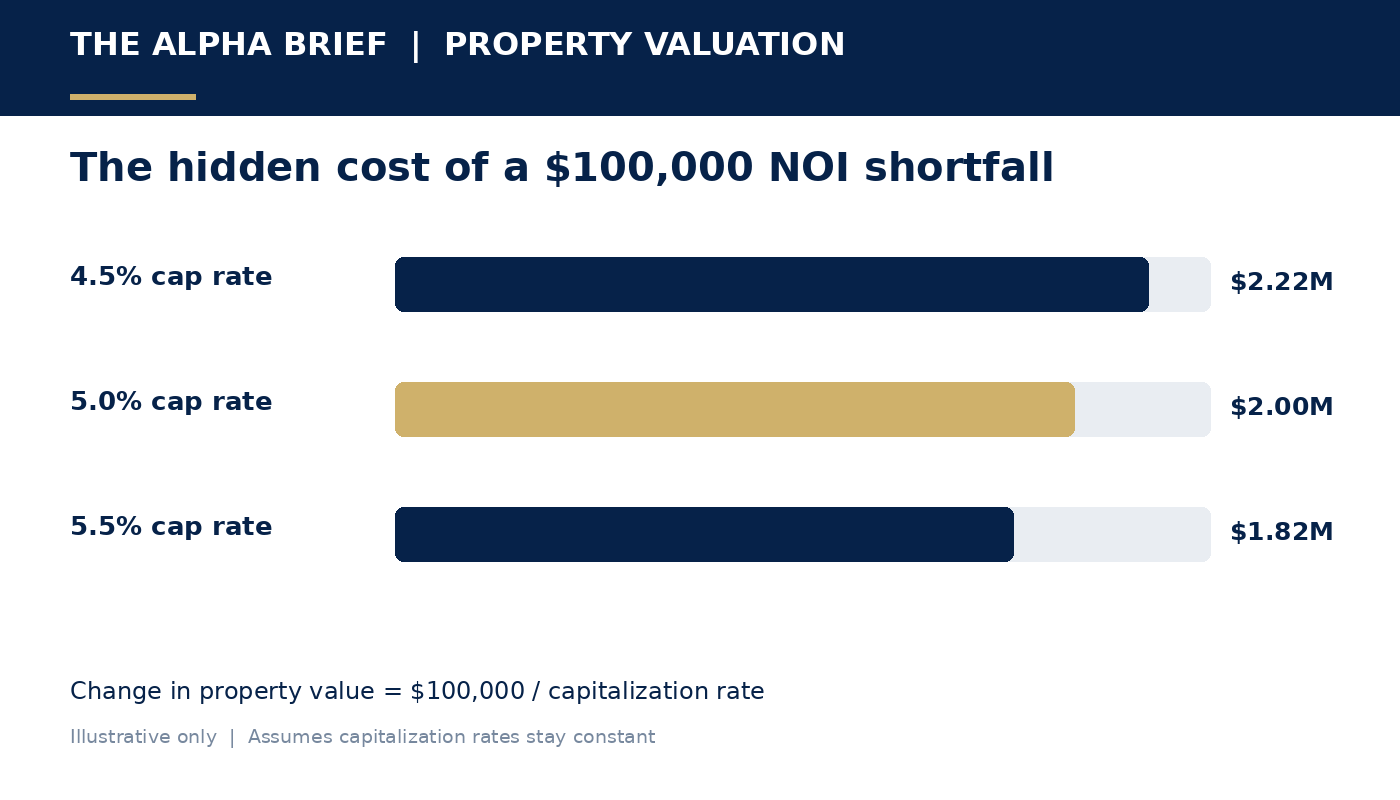
That's a substantial valuation impact from what might initially appear to be a relatively modest operating shortfall.
And when leverage is involved, the consequences for investor equity can be even greater.
This is why disciplined investors scrutinize operating assumptions rather than focusing exclusively on projected returns.
3. Five Questions Every Investor Should Ask
Before committing capital to a private real estate investment, consider these questions:
1. Are the income projections realistic?
Do projected rents reflect actual market conditions, or depend on unusually strong growth?
2. How is the investment financed?
Could rising interest rates, loan maturities, or refinancing challenges affect performance?
3. Who is operating the property?
Does the sponsor have relevant experience executing similar investment strategies?
4. What happens when things don't go according to plan?
Has the investment been evaluated under scenarios involving lower occupancy, higher expenses, or declining property values?
5. Are the sponsor's interests aligned with investors?
Understand the fees, capital commitments, and distribution structure before investing.
These questions won't eliminate investment risk. But they can reveal weaknesses that attractive projections might conceal.
The Cornerstone Perspective: Discipline Over Predictions
As we approach 2027, investors will continue searching for opportunities in private multifamily real estate.
Some will focus on finding the highest projected returns.
Others will focus on understanding the fundamentals supporting those returns.
At Cornerstone Partners Group, our investment philosophy emphasizes disciplined underwriting, thoughtful operator evaluation, and understanding downside risk before allocating capital.
Because successful investing isn't simply about identifying opportunities with compelling projections.
It's about recognizing when the potential reward justifies the risk.
Interested in learning how private multifamily investments may fit into your broader wealth strategy?
Schedule an Introductory Call to learn more about Cornerstone Partners Group and our investment approach.
Disclaimer: This article is for educational purposes only and does not constitute investment, legal, or tax advice or an offer to sell securities. All financial scenarios are hypothetical. Projected returns are not guaranteed. Private real estate investments involve substantial risks, including illiquidity and potential loss of principal.